

Three fuel-stop habits, in the order I tried them
I Did Three Things at Every Fuel Stop.
None of Them Touched the Glare.
 by Ray DelgadoTwenty-one years OTR · last updated Feb 24, 2026
Yes, the new LED headlights really did get brighter. That part is not in your head, and AAA put a number on it this year. But I clean that windshield more than anybody I know — squeegee at every fuel island, blades I replace on schedule, glass cleaner at the end of a shift. By hour eleven the glare was exactly where I left it. What follows is what each of those three habits actually acts on, and the one thing none of them ever reached.
-
1
The squeegee at every fuel island
Acts onBugs and loose grime
Two minutes at every stop, both arms up, working the top of a pane that is taller than I am. It takes off what is sitting loose — bug splatter, grit, the worst of the salt. I assumed that was the whole job.
It never lifted the layer underneath. The glass came off that squeegee looking clean and still threw the same halo at the first truck that came the other way.
-
2
New blades and a full tank of washer fluid
Acts onWater, not the film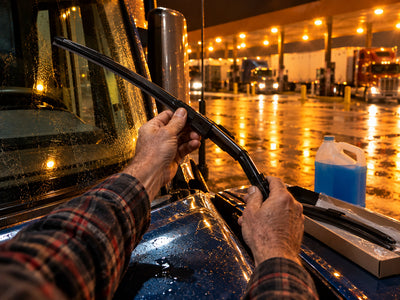
Both were overdue, both were worth doing, and neither had anything to do with the problem. Rain cleared faster. The oncoming halo was exactly where I left it.
Worse, the blades are part of how the film gets there. Every pass drags a thin residue back across the glass.
-
3
Glass cleaner and a blue shop towel
Acts onWhat's loose, not what's bonded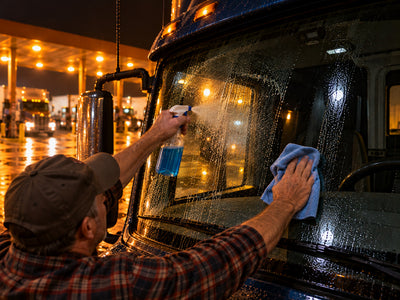
This is the one that fooled me longest, because the glass looked perfect under the lights in the lot. Then I pulled onto the ramp, the first set of headlights hit it, and the haze came straight back.
A cleaner is built for what sits loose on top — not for a layer that has bonded on over years of diesel exhaust, bug residue and road salt.
-
✓
The windshield itself
Acts onThe film that does the scatteringDiesel exhaust, bug residue, road salt and whatever comes back off the blades leave a thin oily layer on the outside of the glass. By day it is invisible. Hold a flashlight flat against it at a fuel island and you will see it.
At night every beam that hits that layer gets spread sideways across the whole pane — right where you are reading the lines. A truck windshield is tall and near vertical, so it collects more of it than a car ever will.
Take that layer off and a beam stays a beam. The headlights are exactly as bright as they were. They just stop smearing.
“Clean glass really does make a difference even if headlights still threaten migraines.”— a driver in r/fuckyourheadlights, a forum that exists purely to complain about headlights
The part I had backwards
Before you file this under that is just what nights are
of US drivers have trouble with headlight glare at night
of them say it has got worse over the last ten years
point at oncoming headlights specifically
In that same survey, age made no statistically significant difference to who struggles. Sex did, and so did wearing glasses. The number of years you have been behind the wheel did not. Those figures cover US drivers generally, not truck drivers specifically — nobody has run that survey on us.
You can’t dim their headlights, and you can’t skip the night shift. But the film on your windshield is taking every one of those lights and spreading it across eleven hours — and that part is yours to fix.
Do half the windshield and let one night decide.
You do not have to believe any of this. Treat one half, leave the other, then run the stretch you like least. Same road, same headlights, a line straight down the middle of your own glass. One fuel stop is enough time.


Then I found the one thing that goes after the film itself
Once I understood what the problem actually was, the search got easier — and a lot shorter. Almost everything sold for car glass is built to clean the surface. Very little is built to take off the layer that has bonded to it.
There is a commercial reason for that. A cleaner you reach for every weekend is a better business than something you use once and forget for three months.
What I ended up with does two things, in this order:
Strip
It breaks down the bonded oily layer and lifts it off, rather than washing over the top of it. This is the part a glass cleaner is not built to do — and the part you can check by flipping the pad.
Seal
With the glass finally bare, it leaves a slick layer behind. Water beads and rolls instead of smearing, and new road film has less to grip. That is what buys you the next three months.
Light goes through instead of scattering sideways. Water beads instead of sheeting. The headlights are exactly as bright as they were — they just stop smearing across the glass in front of you.
It is called InstantClean.
Not a glass cleaner. Not a rain repellent. Not another coating sprayed over the top of the problem — a treatment that takes the film off first, then leaves the glass slick enough to stay that way for a while.
90 days, and you keep the applicator
The cover runs a full 90 days. If the glass falls short of what this page promises, tell us inside that window and we put it right or send your money back.
- A 90-day windowNot convinced by how the glass holds up? You have 90 days from delivery to tell us, and we will set it right or refund you.
- Tracked shippingEvery order leaves with a tracking number, out of a US warehouse inside 24 hours.
- A person answersWrite to info@get-instantclean.com and a human writes back — no bot, no queue.

Two applicators,
pay for one
$54.99 $116.50
Covered by the 90-day promise up top.
If you run nights and you’ve already done the squeegee, the blades and the cleaner, the thing you have not cleaned is the glass itself. It cost me three minutes and one winter of not flinching at every set of headlights.